An ancient super-lake, now a shimmering white horizon with a meerkat problem. The strangest two nights you will add to a safari, and possibly the best.
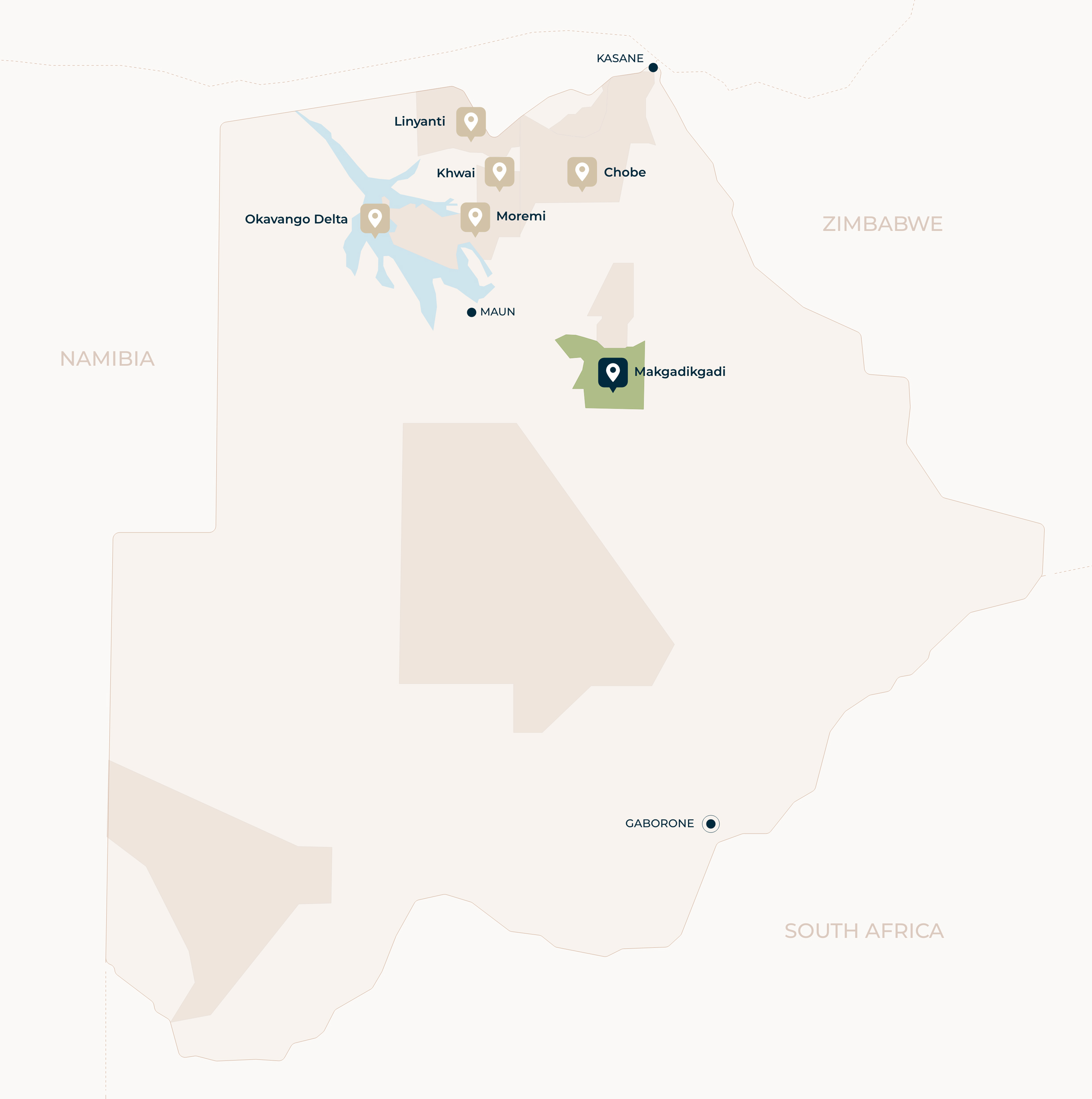
The Makgadikgadi Salt Pans stretch across north-eastern Botswana, south-east of Maun, over one of the largest networks of salt pans on Earth.
An ancient super-lake
A dried-up prehistoric lake, now home to one of the largest salt pan networks on Earth.
Dry season adventure
May to October brings quad biking, meerkats, brown hyena and nights spent under endless stars.
When the rains arrive
November to April floods the pans, bringing zebra migration and huge flamingo flocks to the shallows.
A different kind of journey
Two nights here reshapes an entire trip, adding something genuinely different to everything else.
What Makes Makgadikgadi Special?
Contrast, mostly. After the Delta’s water and Chobe’s elephants, the pans offer something else entirely.
The Empty Horizon
The pans offer silence, distance and a horizon with nothing on it, one of the most memorable sights in Africa. It’s a place for experiences you can’t have elsewhere in Botswana: walking with Zu/‘hoasi San guides who read the desert like a newspaper, and sleeping out on the salt crust itself.
Where Sightings Are Earned
The wildlife here is subtle rather than absent: brown hyena, aardvark, bat-eared fox, gemsbok, springbok and black-maned Kalahari lions, all species the water-rich north rarely shows you. Sightings take patience, but they reward it, in a landscape built for exactly that kind of looking.
When is the Best Time to Visit Makgadikgadi?
Makgadikgadi offers a different experience depending on the month. The best time to visit depends less on the calendar and more on the experience you’re looking for.
Dry Season
Green Season
Dry Season
May to October is for the classic desert experience: quad bikes, meerkats, sleep-outs and endless white under a huge open African sky.
Green Season
November to April floods the pans and brings tens of thousands of migrating zebra, wildebeest, and flamingos across the shallows.
Where is Makgadikgadi Salt Pans and what regions does it pair well with?
The Makgadikgadi Salt Pans sit south-east of Maun, with Nxai Pan just to the north, the Okavango Delta to the north-west, and the Boteti River marking the region’s western boundary. Maun is the usual gateway in, a short flight away..
Two nights here pairs naturally with the Delta, and it’s one of the easiest ways to add real contrast to a Botswana itinerary.
Most guests arrive by air from Maun, connecting easily with the rest of a Delta itinerary.
By air from Maun
Light aircraft from Maun take around 30 to 40 minutes, the quickest and most common way in.
Onward with ease
Flights connect easily with Delta airstrips, which is why the pans slot onto the start or end of a trip.
By road for some camps
Road transfers from Maun are possible for a handful of camps, though nearly all guests choose to fly.
What Can You Do on the Pans?
The activity list reads unlike anywhere else in Botswana, built entirely around this landscape and nothing else.
By vehicle or on foot
Game drives in search of desert specialists, guided bush walks with Zu/‘hoasi San trackers, and quiet meerkat mornings.
Bikes, horses, baobabs
Quad biking across the crust in the dry months, horse riding at select camps, baobab visits, and star beds on the open pan.
Migration season
In the green season, the zebra migration and flamingo colonies take centre stage, viewed from vehicles and on foot.
Where to stay in Makgadikgadi
Three sister camps from Natural Selection cover the range. Jack’s Camp is the icon: part expedition tent, part museum, wholly unlike anywhere else on the continent, and home to a pioneering meerkat habituation project. San Camp is its serene, seasonal sibling on the very edge of the pans. Camp Kalahari is the relaxed, family-friendly option that delivers the same experiences at a friendlier rate. All three share guiding that is among the best in Botswana.
As a two-night add-on, the pans deliver more distinctiveness per dollar than almost anything else in Botswana.
Nightly Rates
Rates run from accessible at Camp Kalahari to around $2,000+ per person per night at Jack’s Camp in peak season.
Conservation Levy
A community conservation levy applies per person per day, quoted separately and applicable right across the area.
All-inclusive Activities
Rates are all-inclusive of the region’s signature activities, from meerkat mornings to guided walks with San trackers.
Makgadikgadi Salt Pans FAQs
What is the Makgadikgadi known for?
The Makgadikgadi is famous for its vast salt pans, open landscapes and seasonal wildlife spectacles. It offers a completely different safari experience from the Okavango Delta, with dramatic scenery and a strong sense of space.
When is the best time to visit the Makgadikgadi Pans?
The best time depends on what you want to experience. The dry season is ideal for the salt-pan landscapes, while the summer rains attract migrating zebra, wildebeest and large numbers of birds.
Can you see wildlife in Makgadikgadi?
Yes, although the wildlife experience is very different from the Delta. You may see zebra, wildebeest, brown hyena, meerkats and desert-adapted species, with particularly good wildlife during the green season.
How many nights should you spend in Makgadikgadi?
We recommend two to three nights in Makgadikgadi. This gives you time to enjoy the landscapes, wildlife and activities before combining it with a more traditional big-game safari elsewhere in Botswana
Is Makgadikgadi worth adding to an Okavango safari?
Yes, it makes an excellent contrast to the Okavango Delta. Combining the two gives you both water-rich wilderness and the vast open landscapes of Botswana’s salt pans, making the overall safari far more varied.
More Botswana Safari Areas to Visit
Each area brings something new to your safari: different landscapes, different wildlife and different ways to experience them. See where else you could go.
Tell us when you would like to travel and what matters most. We’ll shape a Makgadikgadi itinerary around the season, your budget and the way you like to safari.
We use cookies to enhance your experience on our website. By continuing to browse, you consent to our use of cookies. You can manage your cookie preferences at any time through your browser settings. Read our Cookie Policy and Privacy policy